
Hearing the Sound: Using Sound to Understand and Protect a Changing Ocean
Many of us may think of the ocean as quiet, but beneath the waves lives a vibrant and constant world of sound. From Sperm whale clicks to the crack of Snapping shrimp claws, the ocean is teeming with diverse and fascinating noises.
For marine mammals, sound means survival. These animals communicate, hunt, navigate, play, rest, and socialize through acoustic cues. With the continual rise of underwater noise caused by humans, these intricate and vital sounds are in danger of being drowned out. To understand these impacts and help protect the most vulnerable species, scientists can use a powerful listening tool to gain insight into this evolving marine soundscape: the hydrophone.
What is a hydrophone and why do they matter?
A hydrophone is essentially an underwater microphone. Instead of capturing changes in air pressure (like a traditional mic), it detects underwater pressure fluctuations and converts them into electrical signals. These signals can then be amplified, recorded, and transformed into digital audio that can then be analyzed by scientists.
Hydrophones allow researchers to listen to whale and dolphin vocalizations, reef soundscapes, vessel noise, storms, seismic events, underwater construction, and more!
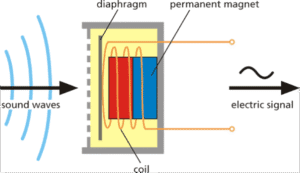
Here we can see sound waves moving into a microphone. The sound wave vibrations then travel around the coil and create an electrical signal by using the magnetic field of the magnet. The magnet is essentially creating something for the coil to move against as it vibrates, which then produces electrical signals.
Hydrophones do more than record sound—they offer us a way to understand marine mammals and monitor ocean noise. Sound is one of the first and most sensitive indicators of stress. Scientists can detect changes in behavior, identify habitat disturbances, and measure how much human noise interrupts marine mammal life. This intimate glimpse into the lives of marine mammals is an incredible tool for us to experience what anthropogenic noise sounds like underwater and how they react to it.
What is Noise Pollution?
Noise pollution is the artificial increase of ambient noise levels due to sound-generating human activities. Due to their negative impacts on wildlife, they can be referred to as anthropogenic noise. Some sources of anthropogenic noise include:
- Commercial shipping
- Recreational vessels
- Military sonar
- Seismic surveys for oil and gas
- Pile driving
- Explosions
- Fish finders and sonar in recreational vessels
The natural world is filled with sound, and these natural sounds have been around for a very long time. As a result, animals have had time to adapt along with these sounds and live in harmony with them. When we introduce inorganic sounds at a speed which animals cannot adapt to or are not biologically capable of adapting to, we can cause a lot of harm.
Marine mammals rely on sound more than terrestrial animals rely on sight. Sound is how marine mammals communicate with family members, find and hunt prey, locate and attract mates, navigate, avoid predators, and rest.
When overwhelming or disruptive noise intrudes into their space, marine mammals may abandon feeding opportunities or rest, be unable to communicate or find each other, halt or abandon mating or birth, or alter migration patterns. Elevated noise levels can also lead to temporary or permanent hearing loss and increase stress, leading to altered psychological states.
In more extreme cases, intense noise like sonar has been linked to mass stranding events. One hypothesis of this correlation is that the exceptional stress response from these particularly loud events can cause whales to alter their diving patterns in their panicked attempt to flee, leading to an excess of nitrogen in their blood as they ascend and descend faster and more sporadically than they would normally. This buildup of nitrogen in the blood can lead to hemorrhaging, organ damage, difficulty breathing, and confusion.
Marine Mammals and Acoustic Communication
Marine mammals use clicks, whistles, songs, and calls to communicate underwater. Whales, dolphins, and porpoises are all cetaceans. While all marine mammals are sensitive to underwater noise, cetaceans are particularly sensitive as they have a broader hearing range. This group all shares the same importance of underwater sound to navigate, communicate, and hunt. Pinnipeds, like seals and sea lions, are adapted to hear above and underwater, which are typically lower in ranges of frequency thus limiting their auditory scope. Pinnipeds remain highly susceptible to underwater noise, especially during breeding and nursing seasons.
Cetacean acoustics can be incredibly distinct based on population, location, and purpose. For example, Humpback whale songs are long and structured vocalizations typically used by males to attract mates. Orcas have their own songs, but they are shorter calls and not the continuous, melodic song we might usually think of. For echolocation, the emission and interpretation of soundwaves to navigate and find things, orcas use short high-pitched clicks. Humpbacks, on the other hand, will produce a longer, low-frequency sound.
Even within the same species, acoustics can vary greatly. The Southern Resident killer whales and the Northern Resident killer whales, while occupying a similar region and sometimes encountering each other underwater, speak a similar dialect but with different accents. The Chugach transient orcas, a population in a specific region of Alaska, could not speak with the Northern or Southern Resident orcas because they speak entirely different languages!
Listening, Learning, and Leaving It Better Than We Found It
In places like the Puget Sound, hydrophones have become indispensable for tracking the health and behavior our local orca species, the Southern Resident killer whales and Bigg’s killer whales. The distinct calls of these orca populations have long been studied, recorded, and interpreted by scientists. Longterm and consistent hydrophone studies are necessary for understanding how alterations in vocalizations may be indicative of stress and altered behavior.
With a hydrophone, CHB can:
- Track behavior during vessel encounters
- Detect stress responses
- Analyze changes in amplitude, frequency, and occurrence of calls
- Understand how whales alter their communication with noise pollution
With your support, we can deepen and strengthen our understanding and protection of the South Sound, and the whales who call it home.
Sources:
Amaral, K. (n.d.). Marine mammal vocalizations: Language or behavior?. Marine Mammal Acoustics. https://www.whoi.edu/science/b/people/kamaral/marinemammalacoustics.html
Fernández, A., Edwards, J. F., Rodríguez, F., de los Monteros, A. E., Herráez, P., Castro, P., Jaber, J. R., Martín, V., & Arbelo, M. (2005). “gas and fat embolic syndrome” involving a mass stranding of beaked whales (family ziphiidae) exposed to anthropogenic sonar signals. Veterinary Pathology, 42(4), 446–457. https://doi.org/10.1354/vp.42-4-446
NOAA Fisheries. (2023). ESA Acoustic Threshold Summary. NOAA NMFS. https://www.fisheries.noaa.gov/s3/2025-09/ESA-AllSpeciesThresholdSummary-2025-508-OPR1-9.16.25-.pdf
NOAA Fisheries. (2025). Marine Mammal Acoustics. https://www.fisheries.noaa.gov/new-england-mid-atlantic/science-data/marine-mammal-acoustics
NOAA (National Oceanic and Atmospheric Administration). (2018). What is a hydrophone?. NOAA’s National Ocean Service. https://oceanservice.noaa.gov/facts/hydrophone.html
Slabbekoorn, H. (2019). Noise pollution. Current Biology, 29(19). https://doi.org/10.1016/j.cub.2019.07.018
Whale Sound. (2025). How we listen. https://whalesound.ca/how-we-listen/
Article Image Credit:
Photo Courtesy of Flip Nicklin. Image number 00439463, Nature Picture Library. Photo obtained under NMFS permit 0753-1599.