
Little Robot, Big Impact: How ROVs Can Help Us Protect and Restore Kelp and Eelgrass
When you think of the Puget Sound, underwater forests and meadows might not be the first things that come to mind, but they are invaluable and integral parts of our local waters. Eelgrass meadows strengthen sediment and create safe nurseries for young animals. Kelp forests absorb carbon, buffer noise pollution, and provide shelter. These habitats anchor ecological and human communities alike, yet both are under increasing stress, and in many places, they’re disappearing faster than we can study them.
Enter the ROV: a small, highly maneuverable, unoccupied underwater vehicle that’s changing how we understand and protect these fragile ecosystems.
What is a ROV?
A remotely operated vehicle (ROV) is essentially a submersible robot controlled from the surface using a joystick. They can be as small as a laptop case or as large as a truck, and most come equipped with:
- Still and video cameras
- Lights
- A tether that sends real-time information back to the operator
Depending on the intended use, ROVs can be outfitted with water-quality sensors, sampling tools, arms for collecting specimens, or instruments to record environmental changes.
Studying underwater forests is notoriously difficult. Traditional survey methods require divers, boats, good weather, daylight, and strict safety limits. Some areas—cold, deep, rocky, or cluttered with debris—are simply too dangerous or inaccessible. Scuba diving is time and resource intensive, sometimes dangerous, and has time and spatial constraints as the divers can’t access every nook and cranny or stay down as long as they like.
ROVs can bypass these limitations. They’re:
- Non-invasive
- Efficient and cost-effective
- Capable of extended underwater time
- Able to access tricky or deep-water zones
- Consistent and easily replicable, making long-term monitoring possible
This matters deeply in places like South Puget Sound, where experts estimate 80% of kelp forests have been lost since 1950, and where eelgrass beds are declining under the pressure of pollution, development, warming water, and other stressors.
With roughly 70% of Earth covered in ocean—and an average depth of 3,682 meters— ROVs give us an intimate look into these elusive spaces.
The towering world of kelp forests
Kelp forests are dynamic ecosystems, full of movement, light, and life. All giant kelp species are a type of brown algae, so they are not plants, rather protists. While they are plant-like, they are actually a completely different classification from plants. Protists are not plants, animals, or fungi; they can be unicellular or multicellular, like kelp. They also create their own food via photosynthesis. ROVs can navigate through kelp beds to document canopy coverage, density, species composition, and overall forest structure.
Underwater video reveals which species are using kelp forests and where—from rockfish finding safety in the stipes, snails clinging to the fronds, and sea urchins grazing. In areas where sea urchins overgraze kelp, ROVs provide accurate density counts and help identify zones needing intervention or removal.
In the Puget Sound, we are mostly concerned with bull kelp (Nereocystis lutkeana), a giant algal species. Many organizations around the Sound are testing methods to restore bull kelp, an annual species that can grow up to 100 feet in a single growing season. ROVs allow repeated, non-destructive monitoring of these giant algae species.
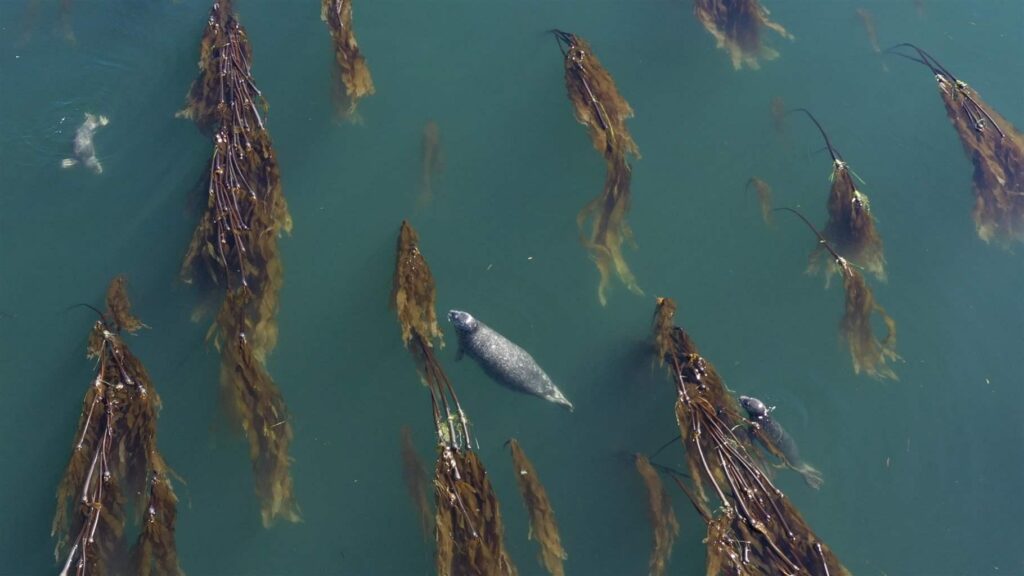
Harbor seal adult and pups in a bull kelp bed in Edmonds, WA. Photo courtesy of The Pew Charitable Trusts.
Bull kelp provides shelter, nursery habitat, acts as a carbon sink, absorbs sound which mitigates noise pollution, is a food source, and is a natural buffer for coastlines. Bull kelp also holds cultural and spiritual significance for many Indigenous peoples such as the Samish and Haida. Samish Indian Nation elder Leslie Eastwood describes kelp as “…an immortal being that watches over and protects all of our Samish people”. Kelp is a resource, tool, and symbol that connects people to the sea. ROVs help track the health of this species and its habitat, supporting long-term stewardship efforts grounded in Indigenous knowledge.
The sprawling world of eelgrass
Eelgrass (Zostera marina) forms the green “fringes” of many Puget Sound shorelines. Eelgrass is not seaweed but a flowering plant, complete with roots, blades, flowers, and seeds. Eelgrass has the ability to stabilize sediments, oxygenate the seafloor, store carbon, and host species ranging from juvenile salmon to Dungeness crab.
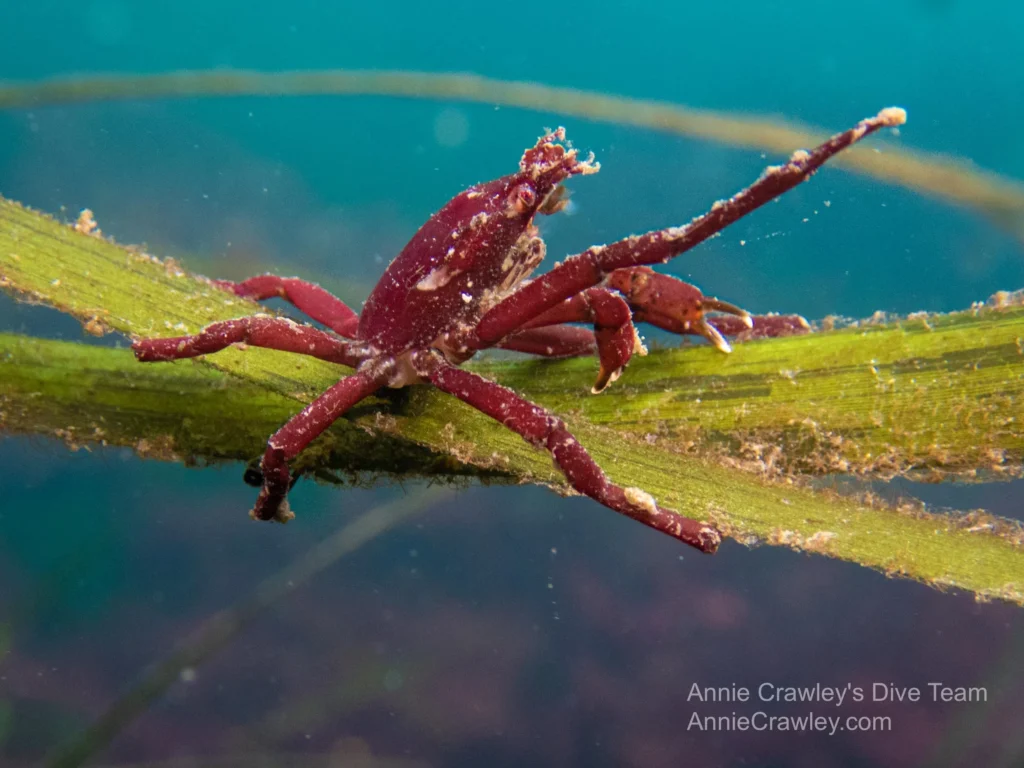
Cryptic kelp crab on seagrass blades. Photo courtesy of Annie Crawley.
Because eelgrass is so sensitive to water quality and environmental stressors, it’s considered a sentinel species—a natural indicator of ecosystem health.
ROVs can glide over shallow meadows and deeper beds alike, providing high-resolution imagery of:
- Bed extent
- Density
- Patchiness
- Signs of stress or decline
- Sediment conditions
ROVs reveal areas with poor biodiversity, high pollution, trash, derelict vessels, shading from docks, or physical damage, all factors that can trigger eelgrass loss.
Long-term footage helps track trends that inform adaptive management and restoration strategies, such as those laid out in the Puget Sound Eelgrass (Zostera marina) Recovery Strategy (2015). The magnitude of stressors is increasing, often in tandem, and has been deemed the cause of localized declines.
Ecosystem Baselines
ROV data can be combined with surface observation data, giving scientists a comprehensive view of habitat conditions and an ecosystem baseline from which to assess change.
This “ecosystem baseline” includes:
- Substrate type
- Algae cover and diversity
- Presence of important species
- Water quality
- Signs of disturbance or pollution
LIDAR and sonar can support mapping in some areas, but each has limitations—LIDAR works only where sunlight penetrates, and sonar risks disrupting marine mammals. ROVs fill this gap, operating quietly across varied habitats.
This baseline is crucial for monitoring changes, designing restoration projects, and evaluating marine protected areas in regions like Les Davis, Titlow, Day Island, Hale Passage, Z’s Reef, Toliva Shoal, and Saltars Point Beach. They allow scientists to move beyond snapshots and into long-term, spatiotemporally significant stories of habitat change. They help tribes, managers, and conservation organizations monitor culturally significant species.
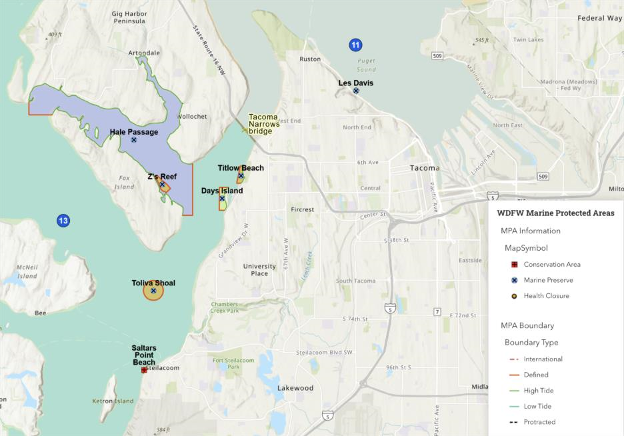
WDFW Marine Protected Areas map courtesy of Washington Department of Fish and Wildlife.
Stewarding the Marine Green
We can’t protect what we can’t see. Having eyes on the underwater world of kelp forests and eelgrass meadows gives us a deeper understanding of what is going on beneath the surface and what we can do to help.
ROVs show us the stark realities of depleted kelp beds, sparse eelgrass meadows, derelict fishing gear, and pollution, but they also offer a way forward to restore and mitigate these anthropogenic impacts. Eelgrass and kelp sustain and protect all of us, and it’s our turn to protect them.
Sources
Buscher, E., Mathews, D. L., Bryce, C., Bryce, K., Joseph, D., & Ban, N. C. (2020). Applying a low cost, Mini Remotely Operated Vehicle (ROV) to assess an ecological baseline of an indigenous seascape in Canada. Frontiers in Marine Science, 7. https://doi.org/10.3389/fmars.2020.00669
Deep Trekker. (2025). Underwater rovs, drones, and Pipe Crawlers: Deep Trekker.
Underwater ROVs, Drones, and Pipe Crawlers | Deep Trekker. https://www.deeptrekker.com/
Dias, A. (2021, February 9). Eelgrass―Zostera marina―ocean ecosystems. Edmonds Underwater Park. https://www.edmondsunderwaterpark.com/blog/eelgrass
Marx, S., & Campbell, B. (2021, October 29). With puget sound kelp in steep decline, expedition seeks to catalyze recovery of vital habitat. The Pew Charitable Trusts. https://www.pew.org/en/research–and–analysis/articles/2021/10/29/with–puget–soundkelp–in–steep–decline–expedition–seeks–to–catalyze–recovery–of–vital–habitat
Mumford, T. F. (2007). Kelp and eelgrass in Puget sound. Washington Department of Fish & Wildlife. https://wdfw.wa.gov/publications/02195
Naar, N. (n.d.). The cultural importance of Kelp for Pacific Northwest tribes. Northwest Straits Commission . https://nwstraits.org/media/2925/appendix_b_the–culturalimportance–of–kelp–for–pacific–northwest–tribes.pdf
NOAA (National Oceanic and Atmospheric Administration). (2025, September 18). How much of the ocean has been explored?. NOAA Ocean Exploration. https://oceanexplorer.noaa.gov/ocean–fact/explored/
NOAA (National Oceanic and Atmospheric Administration). (2020, December 16). What is an ROV?. NOAA Ocean Exploration. https://oceanexplorer.noaa.gov/ocean–fact/rov/
Puget Sound Restoration Fund. (2022, May 5). Eyes on kelp. https://restorationfund.org/programs/eyesonkelp/
Ryan, J. (2022, May 5). Kelp has protected Samish People for millennia. Now it needs their help. KUOW. https://www.kuow.org/stories/reforesting–puget–sound–with–kelp Shepherd, A. (2017). Marine Protected Area assessment on Santa Rosa Island, Channel Islands National Park using underwater remotely operated vehicles (openrov).
ScholarWorks. https://scholarworks.calstate.edu/concern/theses/dr26z053t
Washington Department of Fish and Wildlife. (2025). Marine Protected Areas. Washington Department of Fish & Wildlife. https://wdfw.wa.gov/fishing/management/mpa