
Slow and Steady: The story of the Pinto Abalone Decline and Recovery
Pinto abalone, Haliotis kamtschatkana, is the only abalone species found in Washington waters. These little snails hold deep ecological and cultural significance, intimately tied to Indigenous peoples and providing vital ecosystem functions. Slow-growing and long-lived, pinto abalone are a distinctive resident of Washington’s coastal waters—but also one that has declined rapidly in recent decades. Through sustained collaboration and careful stewardship, there is growing hope that we can shell-ebrate their recovery.
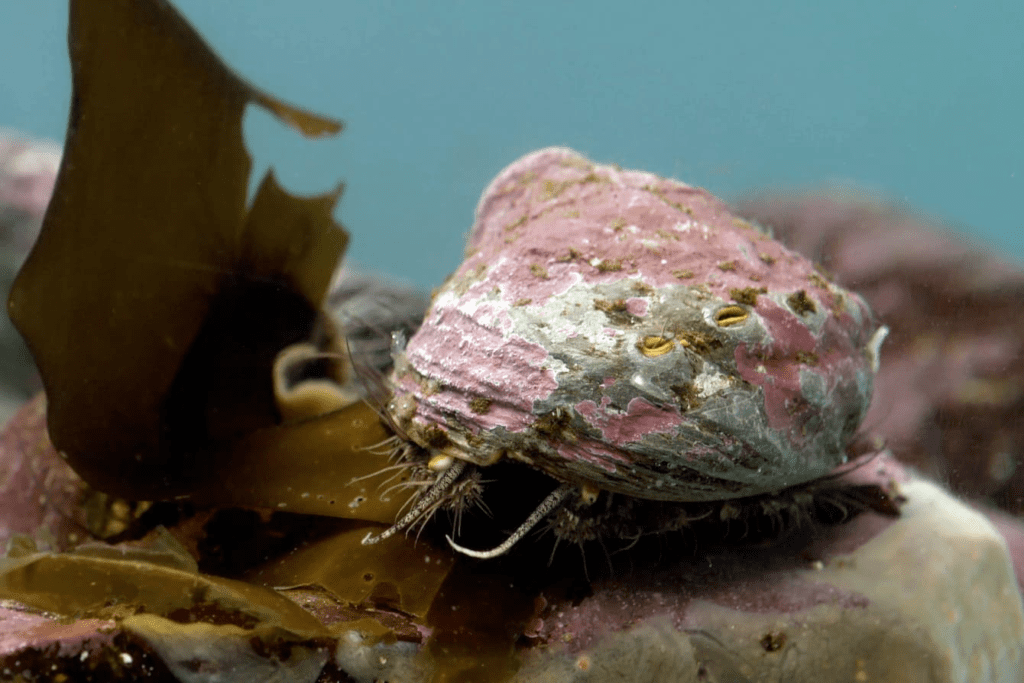
Pinto abalone. Photo courtesy of Seattle Aquarium.
What are pinto abalone?
Pinto abalone are marine gastropods characterized by a single, large, muscular foot used for movement and attachment, and an oval-shaped, pearlescent shell. Shell color and pattern vary widely, often appearing mottled or multicolored with irregular bumps that make each individual unique. Pinto abalone shells have distinctive growth rings that form annually around mid-summer. By counting these rings, we can determine the abalone’s age. This shell also provides protection from predators while the abalone’s powerful foot allows it to suction tightly to rocks, making it difficult to dislodge. When threatened, pinto abalone can also “gallop” away by lifting and propelling themselves with their foot.
Surrounding the foot is a fringe of sensory tentacles called the epipodium, which helps abalone detect food, predators, and environmental conditions. The left side of the shell is slightly elevated to accommodate a series of small respiratory pores that allow water to exit after passing over the gills. These pores play multiple roles, facilitating respiration, waste removal, and reproduction by releasing eggs or sperm into the surrounding water.
Pinto abalone reproduce through broadcast spawning, releasing large quantities of eggs and sperm into the water column, typically between April and July. Successful reproduction depends on adults being close enough together for fertilization to occur. After fertilization, larvae drift as plankton for 7–10 days—smaller than a grain of sand—before settling onto rocks or the seafloor in response to chemical cues from crustose coralline algae and other abalone. Crustose coralline algae is incredibly important for pinto abalone as it provides an ample food source. Their short larval stage, slow growth, irregular recruitment, and reliance on aggregation make pinto abalone especially vulnerable to population collapse.
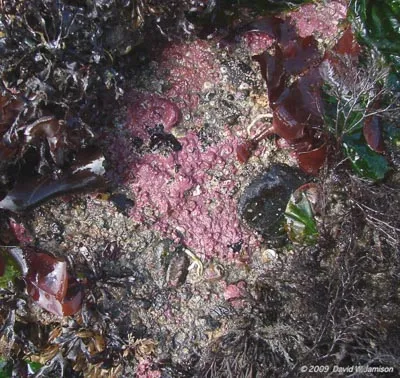
Crustose coralline algae. A member of red algae present in Washington waters. Photo courtesy of David Williamson.
Habitat and Ecological Role
Pinto abalone inhabit nearshore rocky reefs in exposed and semi-exposed coastal areas, typically at depths of around 20 meters. While more than 60 abalone species exist worldwide, H. kamtschatkana is the only one found in Washington. Individuals can live 15–20 years and grow to over five inches in length.
As herbivores, pinto abalone feed primarily on drift macroalgae such as kelp. By grazing and maintaining open substrate, they manage algae populations, help structure subtidal communities, and create conditions that support further abalone settlement. In this way, they contribute to the balance and stability of nearshore marine ecosystems.
The History and Plight of Pinto Abalone
Once widespread throughout Washington and British Columbia, pinto abalone populations have suffered dramatic declines over the past 30 years. Factors including poaching, historical overharvest, degraded environmental conditions, and climate change have all contributed. From 1992 to 2017, the Washington Department of Fish and Wildlife (WDFW) documented an estimated 98 percent decline in abundance. Notably, commercial harvest has never been permitted in Washington, highlighting the severity of non-commercial pressures on the species. Significant data gaps remain, particularly around optimal rearing conditions and how climate change affects reproduction and recruitment.
Two less obvious contributors to the species’ precarious status are sea otters and disease. In areas where pinto abalone populations are already low and unstable, predation by recovering sea otter populations can have an outsized impact. Sea otters preferentially consume larger abalone, often using rocks to pry them from substrate or break their shells.
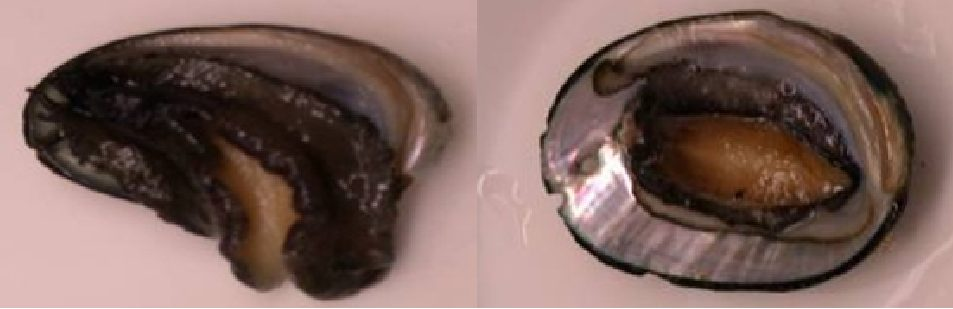
Black abalone with (left) and without (right) withering disease. Courtesy of University of Washington School of Aquatic and Fishery Sciences.
Pinto abalone are also vulnerable to withering syndrome, a fatal disease caused by bacteria that attacks the digestive system. The disease spreads through water and fecal matter and is more severe in warmer conditions, making climate change an added concern. Researchers are actively studying naturally resistant individuals to support breeding programs aimed at increasing population resilience.
Conservation Efforts
Pinto abalone conservation has been underway for more than 25 years across the United States and Canada, though recovery remains slow. Key conservation milestones include:
1998: Listed as a candidate species for protection by WDFW
2000: Listed as Threatened under Canada’s Species at Risk Act
2004: Listed as a federal species of concern by NOAA Fisheries
2006: Formally listed as an Endangered Species on the IUCN Red List
2008: Identified as a Species of Greatest Conservation Need by WDFW
2009: Uplisted to Endangered under Canada’s Species at Risk Act
WDFW conducts regular monitoring at ten index sites throughout the San Juan Archipelago. Because pinto abalone are patchily distributed, total population size is difficult to estimate. Instead, repeated surveys at consistent locations allow scientists to track trends and changes over time.
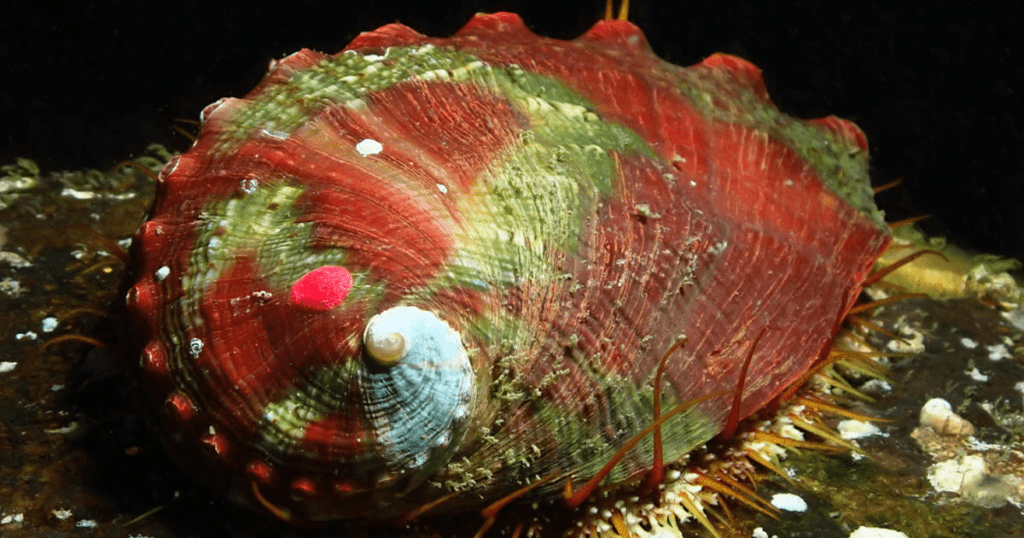
Adult pinto abalone. Courtesy of Washington Department of Fish and Wildlife.
Since 2004, a hatchery-based, multi-organization recovery program has worked to rear pinto abalone in controlled settings and outplant them into suitable rocky habitats. Led by the Puget Sound Restoration Fund in partnership with the Seattle Aquarium, WDFW, NOAA, Port Townsend Marine Science Center, the University of Washington, and Western Washington University, this effort has resulted in the outplanting of nearly 78,000 abalone since 2009. These individuals represent more than 250 genetically distinct families, helping to preserve genetic diversity and strengthen long-term resilience.
Looking Forward
Substantial progress has been made in understanding and supporting pinto abalone recovery, but significant challenges remain. Next steps include developing a comprehensive state recovery plan, expanding field surveys and grow-out facilities, and deepening our understanding of abalone genetics—particularly in relation to disease resistance and climate stressors.
Pinto abalone recovery is, by nature, slow and incremental, but these little snails have a lot of support in their corner. As pinto abalone continue to gallop along, they continue to teach us that even if it is slow, any progress is meaningful.
Sources:
Calle, L. (2025). Raising the next generation of Endangered Pinto Abalone. Washington Sea Grant. https://wsg.washington.edu/raising-the-next-generation-of-the-endangered-pinto-abalone/
Carson, H. S., Morin, D. J., Bouma, J. V., Ulrich, M., & Sizemore, R. (2019). The survival of hatchery‐origin pinto abalone haliotis kamtschatkana released into Washington Waters. Aquatic Conservation: Marine and Freshwater Ecosystems, 29(3), 424–441. https://doi.org/10.1002/aqc.3004
NOAA Fisheries. (2023, September 1). Pinto abalone. NOAA. https://www.fisheries.noaa.gov/species/pinto-abalone
Puget Sound Institute. (n.d.). 2. pinto abalone. 2. Pinto abalone | Encyclopedia of Puget Sound. https://www.eopugetsound.org/science-review/2-pinto-abalone
Puget Sound Restoration Fund. (2025, October 29). Pinto abalone recovery. https://restorationfund.org/programs/pintoabalone/
SeaDoc Society. (n.d.). Pinto abalone facts. https://www.seadocsociety.org/pintoabalone-facts
Seattle Aquarium. (2025, April 25). Species recovery: Pinto abalone. https://www.seattleaquarium.org/conservation/species-recovery/pinto-abalone/
University of Washington School of Aquatic and Fishery Science. (2017). More abalone succumb to withering syndrome disease at higher temperatures. School of Aquatic and Fishery Sciences. https://fish.uw.edu/2017/12/more-abalone-succumb-to-withering-syndrome-disease-at-higher-temperatures/