
Rising Stars: Recovering Sea Star Populations in the Wake of Sea Star Wasting Disease
Sea star wasting disease (SSWD) has driven one of the largest marine invertebrate mass mortality events ever recorded, affecting sea star populations from Alaska to Baja California, Mexico since 2013. For more than a decade, the cause of this devastating disease remained unknown. Among the hardest hit species was the sunflower sea star (Pycnopodia helianthoides), which experienced losses of more than 90% of its global population. As the primary predator of sea urchins, the decline of sunflower sea stars has had profound consequences for trophic cascades and nearshore ecosystem dynamics.
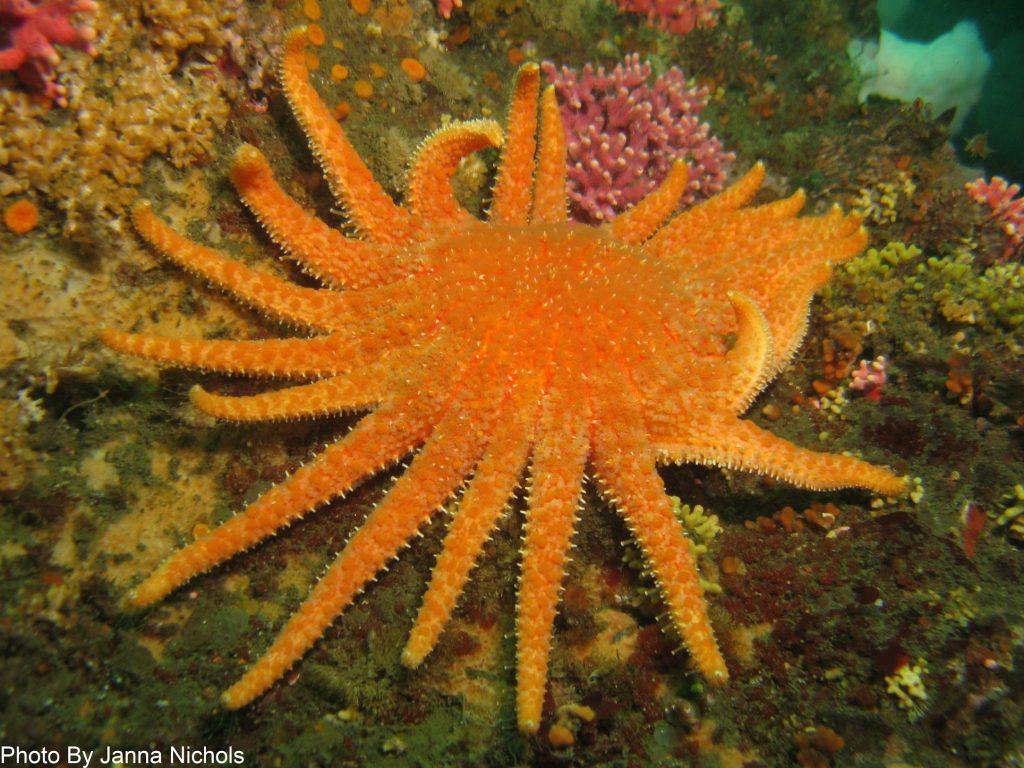
Photo courtesy of Janna Nichols.
Sunflower sea stars are the largest sea stars in the world, capable of growing as large as a bicycle tire and sporting up to 24 arms. They are a keystone species within kelp forest ecosystems. Roughly 20 sea star species have been affected by SSWD,the cumulative loss is staggering with billions of individuals succumbing to the disease. The disease causes the animal to literally waste away – lesions form, tissues soften and disintegrate, limbs contort and detach, and the animal ultimately dissolves.
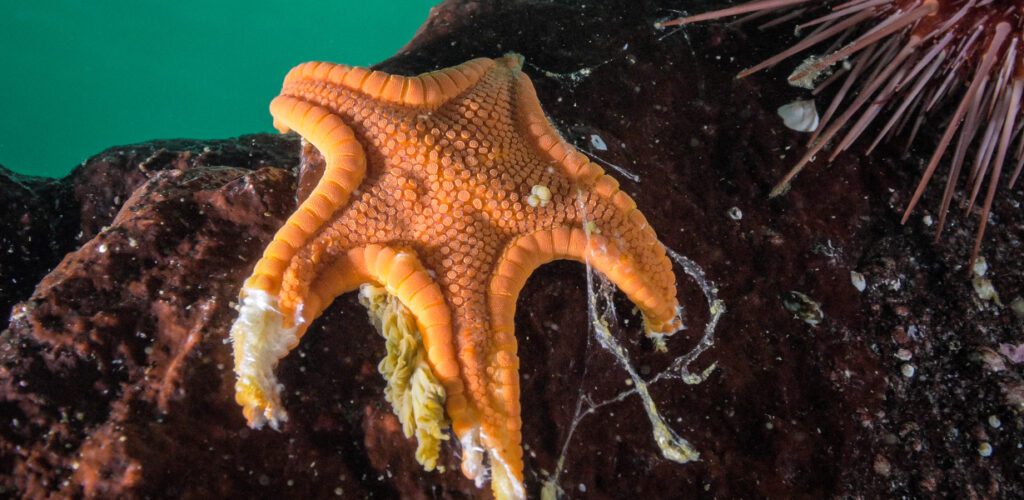
Photo courtesy of The Hakai Institute.
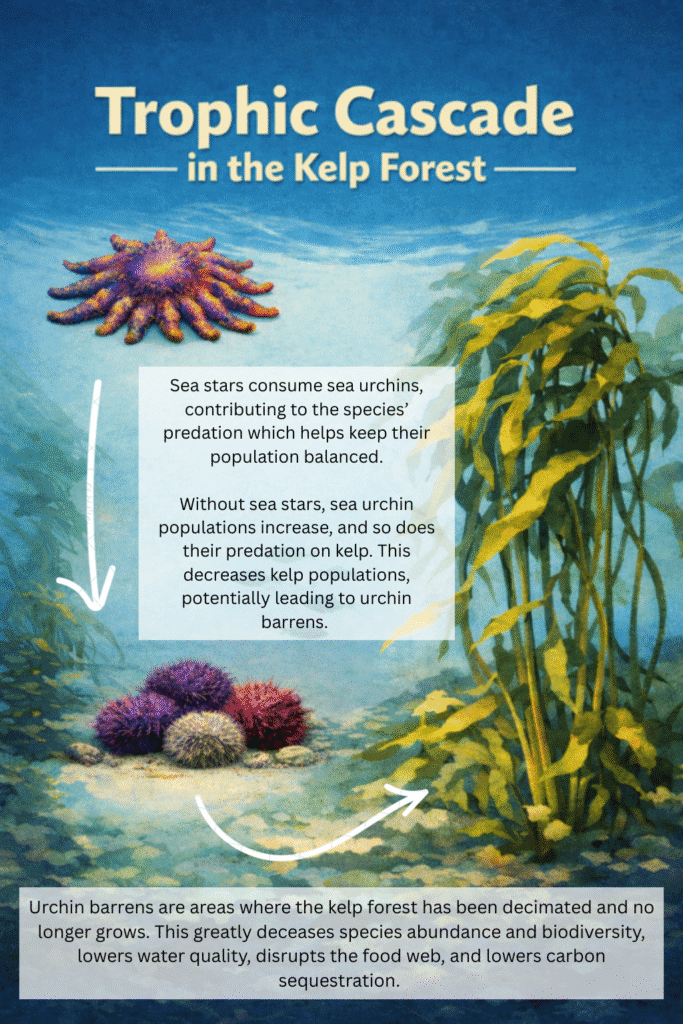
The collapse of sea star populations has had cascading ecological effects. As predation pressure on sea urchins declined, urchin populations surged along the northeastern Pacific coast. Sea urchins are herbivorous grazers that feed on algal detritus as well as live kelp. Since 2014, some urchin populations have increased by as much as 10,000%, and a single group can consume up to 30 feet of kelp forest in a single month. With more mouths to feed, grazing shifted increasingly toward live kelp, contributing to widespread kelp forest loss. These declines directly affect countless species that depend on kelp forests for food, shelter, and nursery habitat.
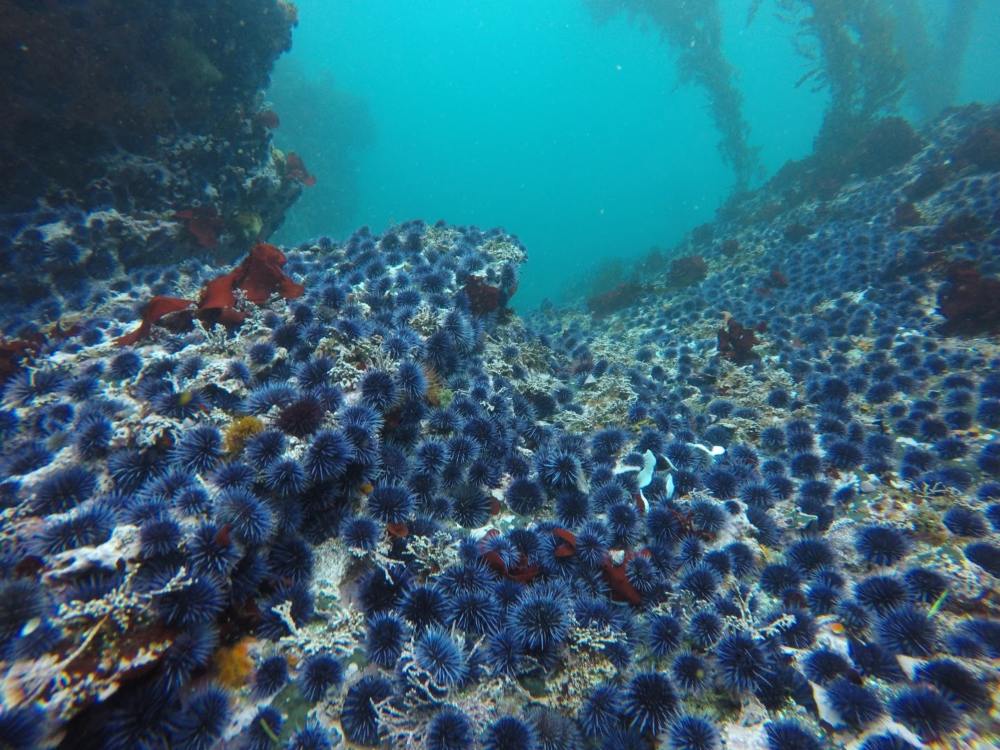
Photo by Steve Lonhart/NOAA.
Kelp forests are not only biodiversity hotspots but also powerful carbon sinks, capable of absorbing and storing up to twenty times more carbon than terrestrial forests through photosynthesis. They provide critical ecosystem services, support coastal fisheries, and hold deep cultural significance for many Indigenous communities. Despite the scale of their loss, efforts to address SSWD were long hindered by uncertainty surrounding its cause.
The Puget Sound has experienced its share of impact. In 2015, the Point Defiance Zoo & Aquarium lost more than half of its sea star collection during a summer outbreak, a season when SSWD tends to intensify due to warmer water temperatures that favor disease spread and progression. In 2023, a University of Washington study documented sharp declines in sea star populations throughout the Sound, along with increased susceptibility in species previously thought to be unaffected.
In August of this year, researchers identified the causative agent of SSWD as Vibrio pectenicida, a bacterium known to thrive in warmer waters. This international research effort included scientists from the University of Washington and representsa major breakthrough in marine disease ecology. Identifying the pathogen allows for more focused and effective recovery strategies, including limiting disease spread, outplanting healthy individuals, captive rearing to preserve genetic diversity, and maintaining up-to-date population data to guide conservation actions.
The loss of sea stars reverberates far beyond a single species, reshaping entire ecosystems. With the discovery of the disease’s cause, scientists, managers, and policymakers are now equipped to develop informed, coordinated recovery efforts. While challenges remain, this breakthrough offers renewed hope for sunflower sea stars and the kelp forest ecosystems they help sustain.
Sources:
Burt, J. M., Tinker, M. T., Okamoto, D. K., Demes, K. W., Holmes, K., & Salomon, A. K. (2018). Sudden collapse of a mesopredator reveals its complementary role in mediating Rocky Reef regime shifts. Proceedings of the Royal Society B: Biological Sciences, 285(1883), 20180553. https://doi.org/10.1098/rspb.2018.0553
Dunagan, C. (2025, July 14). Sunflower sea stars certified as “critically endangered” by International Organization. Puget Sound Institute. https://www.pugetsoundinstitute.org/sunflower-sea-stars-certified-as-critically-endangered-by-international-organization/
Glenn, S. (2015). Point defiance loses half its sea stars to a wasting aquatic disease | Tacoma News Tribune. The News Tribune. https://www.thenewstribune.com/news/local/article34291203.html
Heady, W.N., R. Beas-Luna, M.N Dawson, N. Eddy, K. Elsmore, F. T. Francis, T. Frierson, A.L. Gehman, T. Gotthardt, S.A. Gravem, J. Grebel, S. L. Hamilton, L. Hannah, C.D. Harvell, J. Hodin, I. Kelmartin, C. Krenz, L. Lee, J. Lorda, D. Lowry, S. Mastrup, E. Meyer, P. T. Raimondi, S. S. Rumrill, V. R. Saccomanno, L. M. Schiebelhut, C. Siddon. 2022. Roadmap to recovery for the sunflower sea star (Pycnopodia helianthoides) along the west coast of North America. The Nature Conservancy, Sacramento, CA, US. 44 pages
Hewson, I., Johnson, M. R., & Reyes-Chavez, B. (2025). Lessons learned from the Sea Star Wasting Disease Investigation. Annual Review of Marine Science, 17(1), 257–279. https://doi.org/10.1146/annurev-marine-040623-082617
Hildebrand, L., Derville, S., Hildebrand, I., & Torres, L. G. (2024). Exploring indirect effects of a classic trophic cascade between urchins and kelp on zooplankton and whales. Scientific Reports, 14(1). https://doi.org/10.1038/s41598-024-59964-x
Kohl, W. T., McClure, T. I., & Miner, B. G. (2016). Decreased temperature facilitates short-term sea star wasting disease survival in the Keystone Intertidal Sea Star Pisaster ochraceus. PLOS ONE, 11(4). https://doi.org/10.1371/journal.pone.0153670
McQuate, S. (2025). “the discovery of the decade”: Researchers have found the culprit behind Sea Star Wasting Disease. UW News. https://www.washington.edu/news/2025/08/04/researchers-have-found-the-culprit-behind-sea-star-wasting-disease/
NOAA Fisheries. (2025, September 11). Sunflower sea star. NOAA. https://www.fisheries.noaa.gov/species/sunflower-sea-star
Owen-McLaughlin, N. (2023). Two decades of change in Sea Star Abundance in Puget sound. School of Aquatic and Fishery Sciences. https://fish.uw.edu/2023/06/two-decades-of-change-in-sea-star-abundance-in-puget-sound/
Silburg, J. (2019). A Star is born … and then wastes away again. Hakai Institute. https://hakai.org/a-star-is-born-and-then-wastes-away-again/